
Orangeburg or Clay: What Your Sewer Pipe Is Made Of
Possibly, and no record anywhere will tell you. Bituminous fiber pipe sold as Orangeburg went into house connections from roughly the early 1950s to the early 1970s, and no municipal record identifies which houses have it, so a camera down the line is the only thing that answers the question.
Already know you need someone out? Call (315) 640-3590, answered 24/7.
Two eras of pipe under one county
Housing age is the first filter and this county splits cleanly on it. The median year of construction is 1938 in East Syracuse village, Liverpool village and Skaneateles village, 1947 in Solvay village and 1948 in the City of Syracuse. It is 1956 in Galeville and Westvale, 1958 in Camillus village, 1959 in North Syracuse village, and 1961 in Fairmount and Fayetteville village. Then 1975 in Baldwinsville village, 1977 in Village Green and 1990 in Radisson. Those three groups are three different conversations about what is in the ground. The pre-war and immediately post-war housing is the clay era. The 1950s and 1960s suburbs are the era in which bituminous fiber pipe, sold under the brand name Orangeburg, was going into new house connections as standard.
The federal standard behind Orangeburg never asked how long it would last
This is the detail that explains everything else about the material. The standard behind it is Commercial Standard CS116-44, promulgated by the National Bureau of Standards and effective for new production from March 10, 1944. It covers the pipe in diameters of 2 to 8 inches in 5 and 8 foot lengths, and its first listed use is house connections to sewers and septic tanks. Its durability tests are a 48 hour water immersion allowing a 2 percent weight gain, a 30 day chemical immersion, a boiling water test, and a resistance to flattening test allowing a 3 percent decrease in diameter under load and heat. The longest of those runs thirty days, and the standard contains no service life requirement of any kind. A product qualified against a month of immersion went into the ground under front yards that are now seventy years old.
Which parts of this metro are the Orangeburg era
The census gives it street by street. The share of housing built between 1940 and 1969, the years bituminized fiber sewer pipe was in production under the federal standard, runs 72.3 percent in Fairmount, 71.8 in Seneca Knolls, 71.2 in Westvale, 70.6 in Galeville, 65.4 in Mattydale, 59.1 in Nedrow, 56.1 in Lyncourt and 55.3 in North Syracuse village. By town, Camillus is the highest in the county at 53.4 percent, then Geddes at 51.6 and Salina at 47.7, against a county figure of 34.8. Those are the addresses where a slow drain is worth investigating rather than living with. It is also why a Fairmount house and a Skaneateles house with the same symptom are not the same investigation at all.
How you tell, and the method that can make it worse
The City of Ann Arbor's building department, which deals with the same generation of private lines, describes Orangeburg as the brand name of a bituminous fiber pipe made from plant-based fibers and asbestos soaked in a tar-like substance, manufactured to ASTM D-1861 for the homogeneous pipe and ASTM D-1862 for the laminated wall version, and states that bituminous fiber piping systems have experienced numerous failures over the years with many needing complete replacement. It puts the usage window at roughly the early 1950s to the early 1970s, with reports of it in homes as early as 1949, and says plainly that no municipal record identifies which houses have it. It lists a video scan of the line as the way to identify it, and warns that inserting a rooter, snake or mechanical cutter may yield clues but may also further damage the pipe. Read that last sentence again before booking a clearance on a 1950s house.
Clay is a different problem with a different answer
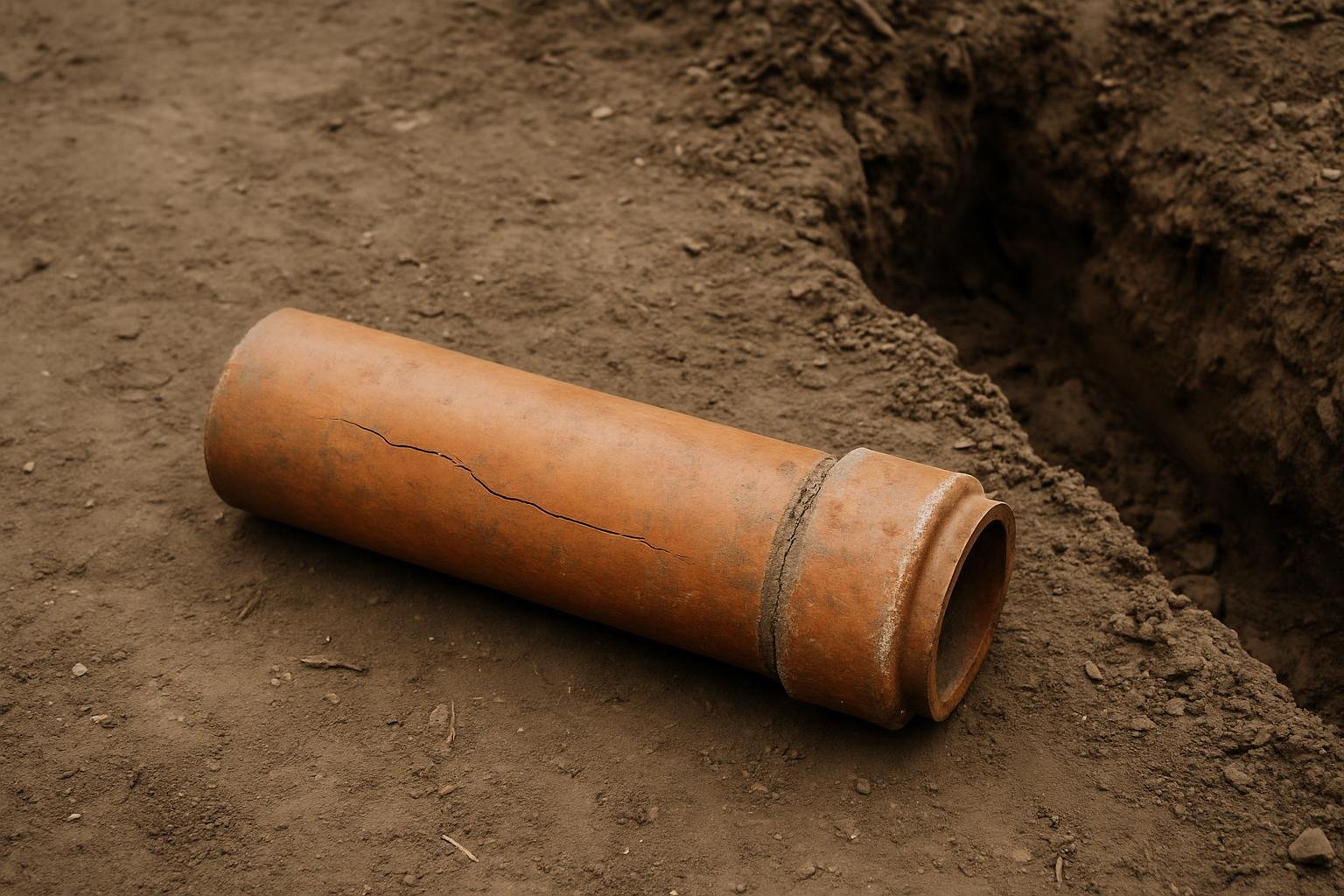
Vitrified clay is not a defective material and it never stopped being legal. Table P3002.2 of the New York residential code still lists vitrified clay pipe to ASTM C425 and ASTM C700 among the materials permitted for a building sewer today, alongside concrete, cast iron, ABS, PVC, polyethylene, copper and stainless steel, while bituminized fiber pipe appears nowhere on that list. What clay does is open at the joints, which is an entry point rather than a collapse, and that is why the oldest housing here is a root story rather than a deformation story. In this county 62.1 percent of East Syracuse village housing predates 1950, along with 61.2 percent in Skaneateles village, 60.4 percent in Liverpool village, 53.6 percent in Solvay village and 51.4 percent in the City of Syracuse. A camera tells the two apart in minutes, and the repair is not the same repair.
Asbestos changes who is allowed to touch the pipe
Bituminous fiber pipe contains asbestos, and so does the asbestos-cement pipe that was legitimately specified around here: Village of Fayetteville Code section 133-13 permits Transite or equal asbestos-cement building sewer pipe where the Superintendent approves it. New York Industrial Code Rule 56 defines an asbestos project as work involving the removal, encapsulation, enclosure, repair or disturbance of friable or non-friable asbestos, sizes a minor project at 25 linear feet or less and a small project at more than 25 and less than 260 linear feet, and at section 56-3.1 forbids any contractor from engaging in an asbestos project without a valid asbestos handling license from the Commissioner. Section 56-1.4 requires the asbestos contractor to tell every other contractor on site that disturbance by anyone else is prohibited, and section 56-1.3 exempts only owner-occupied single family dwellings where the owner performs the work. Raise it before the quote, not after the dig.
Replacing it without opening the whole yard
Section P3010 of the New York residential code allows a building sewer or building drain to be replaced by pipe bursting, and section 3011 allows PVC fold and form. Pipe bursting is limited to gravity drainage piping of 6 inches and smaller, the replacement has to be the same nominal size, and the new pipe must be high density polyethylene to ASTM F714. The code also requires an internal recorded video camera survey both before and after the work, with the after survey reviewed and approved by the building official before pressure testing, and requires cleanout fittings to be installed where the existing sewer did not have them. For a 1950s lateral running under a mature lawn and a driveway, whether the line qualifies for that method is the question that decides what your front yard looks like a month from now.
When the honest answer is that nothing needs doing
Age on its own is not a defect and it is not a reason to replace anything. If the camera shows a round bore, sound joints and a clear run, what you have bought is certainty and a recording, and the correct next step is to keep grease and wipes out of it and look again in a few years. Some of this metro is barely in the conversation: the Town of Clay has 26,282 housing units, the largest stock in the county outside the city, with a median year built of 1978 and only 5.6 percent of it built before 1950, the lowest share in this metro. If your address is in Clay, Radisson or Village Green, deformation of a seventy year old fiber pipe is very unlikely to be your problem, and a slow drain there is a slow drain rather than an omen.
What to ask for, and what we will do with it
Ask for the survey before the diagnosis, and ask to keep the recording, because it is the document every later decision refers back to. Ask what the pipe appears to be made of, and at what distance from the house its condition changes, since that distance is what tells you whether you are looking at a repair to one section or a replacement of the run. Ask whether the line qualifies for a trenchless method. Then tell us what the footage showed, along with your municipality and roughly when the house was built, and we will put you in front of licensed, insured contractors who work that area and quote against what is actually in the ground rather than against what a house of that age usually has.
Sources used in this guide
Median year of construction across the places of this metro: East Syracuse village 1938, Liverpool village 1938, Skaneateles village 1938, Solvay village 1947, Syracuse city 1948, Marcellus village 1952, Mattydale 1953, Lyncourt 1954, Galeville 1956, Westvale 1956, Camillus village 1958, North Syracuse village 1959, Fairmount 1961, Fayetteville village 1961, DeWitt hamlet 1964, Lakeland 1967, Manlius village 1968, Minoa village 1971, Baldwinsville village 1975, Village Green 1977 and Radisson 1990.
Source: US Census Bureau, American Community Survey 2020-2024 5-year, table B25035, accessed 2026-09-08
The federal standard behind Orangeburg pipe is Commercial Standard CS116-44, promulgated by the National Bureau of Standards and effective for new production from March 10, 1944. It covers bituminized fiber pipe in diameters of 2 to 8 inches in 5 and 8 foot lengths, and its first listed use is house connections to sewers and septic tanks. The material is defined as a bituminous compound reinforced with an interwoven fibrous structure. Its durability tests are a 48 hour water immersion allowing a 2 percent weight gain, a 30 day chemical immersion, a boiling water test, and a resistance to flattening test allowing a 3 percent decrease in diameter under load and heat. The standard contains no service life requirement of any kind.
Source: National Bureau of Standards, Commercial Standard CS116-44, via GovInfo, accessed 2026-09-08
Share of housing built between 1940 and 1969, the years bituminized fiber sewer pipe was in production under federal Commercial Standard CS116, in the places of Onondaga County: Fairmount 72.3 percent, Seneca Knolls 71.8, Westvale 71.2, Galeville 70.6, Mattydale 65.4, Nedrow 59.1, Lyncourt 56.1, North Syracuse village 55.3, DeWitt hamlet 51.9, Fayetteville village 45.4, Manlius village 44.3, Lakeland 40.7, Solvay village 39.9, Camillus village 38.1, Marcellus village 35.3, Syracuse city 33.4, East Syracuse village 33.1, Minoa village 29.5, Liverpool village 29.3, Baldwinsville village 22.2 and Skaneateles village 20.8.
Source: US Census Bureau, American Community Survey 2020-2024 5-year, table B25034, accessed 2026-09-08
Share of housing built before 1950 in the towns of Onondaga County: Skaneateles 42.5 percent, Geddes 37.5, Marcellus 36.4, DeWitt 24.5, Salina 24.3, Onondaga 17.1, Van Buren 15.8, Manlius 14.8, Lysander 14.3, Cicero 10.6, Camillus 9.2 and Clay 5.6, against a county figure of 28.5 percent. The 1940 to 1969 shares run the other way: Camillus 53.4 percent, Geddes 51.6, Salina 47.7, DeWitt 43.3, Manlius 36.2, Skaneateles 33.4, Onondaga 33.0, Van Buren 32.9, Cicero 31.4, Clay 29.4, Marcellus 26.5 and Lysander 17.9, against a county figure of 34.8 percent.
Source: US Census Bureau, American Community Survey 2020-2024 5-year, table B25034, accessed 2026-09-08
The City of Ann Arbor's building department describes Orangeburg as the brand name of a bituminous fiber pipe made from plant-based fibers and asbestos soaked in a tar-like substance, manufactured to ASTM D-1861 for homogeneous pipe and ASTM D-1862 for the laminated wall version, and states that bituminous fiber piping systems have experienced numerous failures over the years with many needing complete replacement. It puts the usage window at roughly the early 1950s to the early 1970s, with reports of it in homes as early as 1949, and notes that no municipal record identifies which houses have it. It lists a video scan of the line as a way to identify it and warns that inserting a rooter, snake or mechanical cutter may yield clues but may also further damage the pipe.
Source: City of Ann Arbor, Building, Rental and Inspection Services, accessed 2026-09-08
Table P3002.2 of the New York residential code lists the pipe materials permitted for a building sewer today. Vitrified clay pipe to ASTM C425 and ASTM C700 is still on that list, as are concrete pipe, cast iron, ABS, PVC, polyethylene, polyolefin, copper and stainless steel. Bituminized fiber pipe appears nowhere on it.
Source: 2020 Residential Code of New York State, Table P3002.2, via UpCodes, accessed 2026-09-08
Share of housing built before 1950 in the cities, villages and census designated places of Onondaga County: East Syracuse village 62.1 percent, Skaneateles village 61.2, Liverpool village 60.4, Solvay village 53.6, Syracuse city 51.4, Marcellus village 48.2, Camillus village 41.5, Lyncourt 39.5, Mattydale 37.2, Westvale 28.1, Fayetteville village 24.6, Baldwinsville village 24.0, North Syracuse village 22.0, Galeville 21.4, Minoa village 20.9, Brewerton 15.5, DeWitt hamlet 14.6, Manlius village 12.5, Fairmount 8.8, Radisson 6.9, Village Green 5.4 and Seneca Knolls 2.2.
Source: US Census Bureau, American Community Survey 2020-2024 5-year, table B25034, accessed 2026-09-08
Village of Fayetteville Code section 133-13 specifies cast-iron soil pipe to ASTM A74-42 extra-heavy weight or equal for the building sewer, permits Transite or equal asbestos-cement building sewer pipe if the Superintendent approves it, and states that cast iron pipe with leaded joints may be required by the Superintendent where the building sewer is exposed to damage by tree roots. Section 133-14 sets a minimum inside diameter of four inches at a slope of not less than a quarter inch per foot, and section 133-17 prohibits connecting roof downspouts, exterior foundation drains or areaway drains to a building sewer.
Source: Village of Fayetteville Code Chapter 133, Sewers, accessed 2026-09-08
New York Industrial Code Rule 56 defines an asbestos project as work involving the removal, encapsulation, enclosure, repair or disturbance of friable or non-friable asbestos, or any handling of asbestos material that may release fibers. A small asbestos project is more than 25 and less than 260 linear feet of asbestos containing material; a minor project is 25 linear feet or less. Section 56-3.1 forbids any contractor from engaging in an asbestos project without a valid asbestos handling license from the Commissioner, and section 56-1.4 requires the asbestos contractor to tell every other contractor on site that disturbance by anyone else is prohibited. Section 56-1.3 exempts only owner-occupied single family dwellings where the owner performs the work.
Source: New York State Department of Labor, Industrial Code Rule 56, 12 NYCRR Part 56, accessed 2026-09-08
Section P3010 of the New York residential code governs replacement of building sewers and building drains by pipe bursting. It limits the method to gravity drainage piping of 6 inches and smaller, requires the replacement to be the same nominal size, requires high density polyethylene pipe to ASTM F714, requires an internal recorded video camera survey both before and after the work, requires the after survey to be reviewed and approved by the building official before pressure testing, and requires cleanout fittings to be installed where the existing sewer did not have them. Section 3011 sets out the parallel rules for PVC fold and form replacement.
Source: 2020 Residential Code of New York State, Sections P3010 and 3011, via UpCodes, accessed 2026-09-08
The Town of Clay has 26,282 housing units, the largest stock in the county outside the City of Syracuse, with a median year built of 1978. Only 3.2 percent was built before 1940 and only 5.6 percent before 1950, the lowest share in this metro, while 51.9 percent was built between 1940 and 1979.
Source: US Census Bureau, American Community Survey 2020-2024 5-year, tables B25034 and B25035, accessed 2026-09-08
Services this guide relates to
Need someone to look at it?
Send the details and we will come back to you.