
What a Sewer Repair Costs, and Why Nobody Quotes It Over the Phone
Because until a camera has been down the line, nobody knows whether you are buying an hour with a cable machine or a trench across the yard, and those are not the same job. Buy the survey first: it is the thing that turns this from a fear into a number.
Already know you need someone out? Call (315) 640-3590, answered 24/7.
The order a sewer job runs in, and where the price appears
Say what is happening
You, on the phoneWhich fixtures are slow, whether it happens in dry weather or only in heavy rain, and roughly when the house was built. Three answers, no charge, and they narrow the job before anybody travels.
The municipal check
Your city, town or villageOnondaga County WEP inspects the public side for properties in the Consolidated Sanitary District, with no direct charge and without needing you at home. City of Syracuse properties go to the Department of Public Works instead.
The camera survey
A licensed contractorAn internal video survey of the lateral. This is where the job stops being a guess. New York's code requires a recorded camera survey both before and after a pipe bursting replacement, so the recording has to exist anyway.
The quote
The contractor, in writingScope tied to what the camera saw, at a stated length and depth, with reinstatement and permit named as lines rather than assumed.
Review and permit
WEP Plumbing ControlA Capacity Assurance review is required for new lateral connections to existing mains and for re-use of existing laterals, with feedback or approval provided within 45 days.
Onondaga County Water Environment Protection, the Onondaga County Examining Board for Plumbers requirements, and the 2020 Residential Code of New York State.
The two jobs hiding behind one symptom
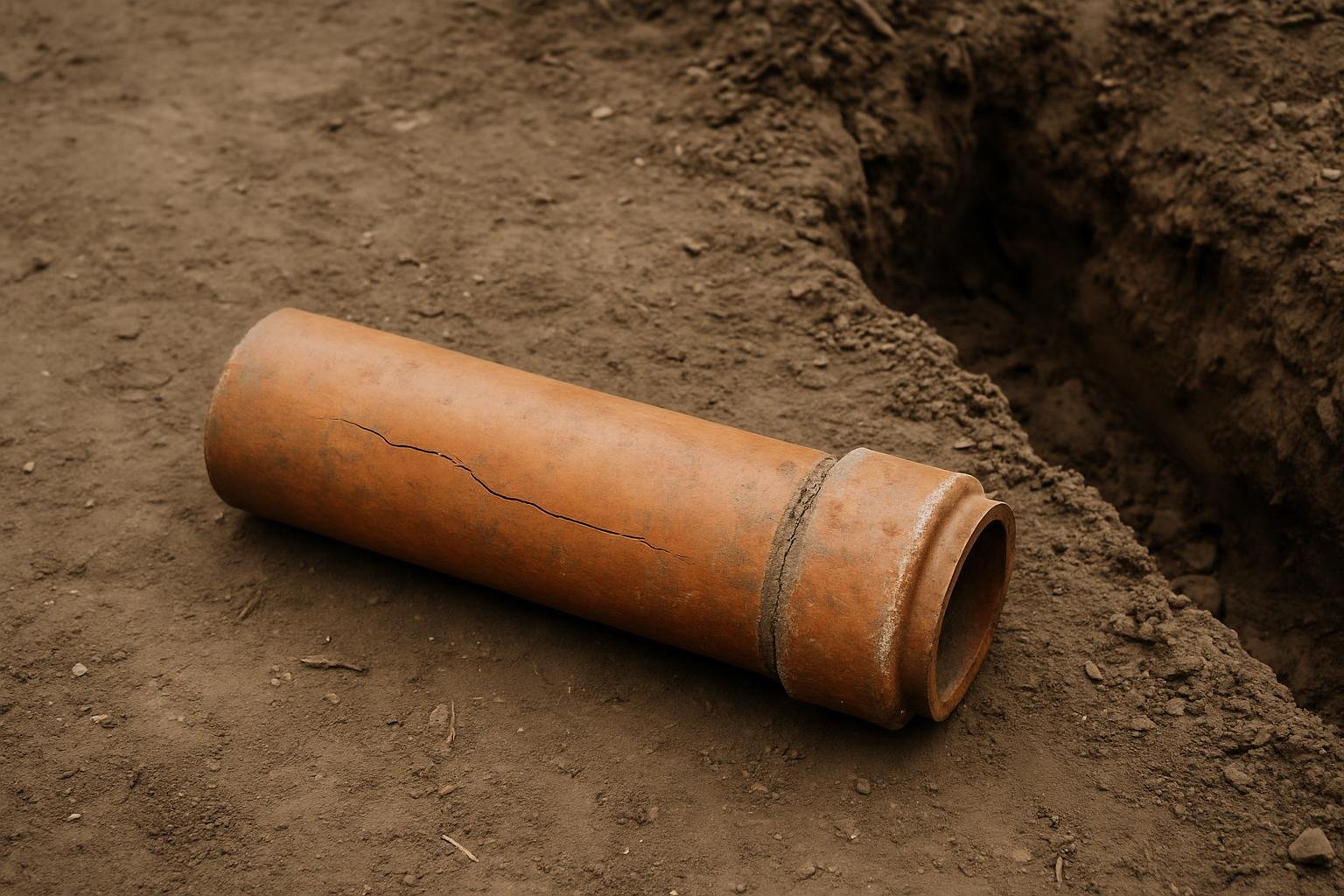
A narrowed drain and a collapsed lateral present identically at the kitchen sink. One is an hour's work at an access point. The other is a length of pipe taken out of the ground and replaced, with a permit, an inspection and a yard to put back afterwards. Nobody can tell you which of the two you have from a description over the phone, and anybody who names a figure before looking is either quoting the small job to win the call or the large one to protect themselves. That is the whole reason this trade has the reputation it has. What can be established quickly, and cheaply, is which of the two you are in. Everything below is about the things that then move the number, so that when a quote does arrive you can see what it is made of.
The survey comes first, and the code already assumes it exists
Section P3010 of the New York residential code governs replacing a building sewer by pipe bursting, and it requires an internal recorded video camera survey both before and after the work, with the after survey reviewed and approved by the building official before pressure testing. In the City of Syracuse the requirement is older and blunter still: section 5.3 A.2 of the county's plumbing requirements says WEP Plumbing Control will make no inspection of a lateral connection unless the contractor has proof the lateral has been flushed by the City Department of Public Works and televised to the main sewer, with the video recording given to the City Sewer Department and to Plumbing Control. So the camera is not an extra somebody invented to pad an invoice. It is a document the job is required to produce, and asking to be given a copy of it is an entirely ordinary request.
Before you pay anyone, make the municipal call
This is the section that may cost us the job, and it belongs here anyway. Onondaga County Water Environment Protection runs a 24 hour line on 315-435-3157 for properties inside the Consolidated Sanitary District. Its crews inspect the public side of the sewer, from the cleanout or vent pipe in your yard out to the road and into the public sewer. There is no direct charge for that visit and you do not need to be at home for it, and if the fault is not in the public sewer the department refers the property on to a licensed plumber or drain service. City of Syracuse properties call the City Department of Public Works on 315-448-2489 instead. Make that call before you book anything private. If it turns out to be on the municipal side of the line, you have paid nobody and the problem belongs to somebody else.
Length and depth are what actually move the number
Section 5.5 A of the Onondaga County Examining Board requirements sets minimum cover for a building sewer at 48 inches, and describes the same 48 inch figure for pumped sewers and force mains as 6 inches more than frost depth. Domestic water services go deeper again at 54 inches, and fire service lines deeper still. Those numbers explain why an excavation here is never a shallow scrape: the pipe is four feet down before anything else is true about it, and depth widens the trench that has to be opened to reach it safely. Length does the same thing more obviously. A lateral running fifteen feet from a city house to the curb and one running eighty feet down a suburban front yard are not the same job at any price. When a quote arrives, the two figures to ask for beside it are the length being worked on and the depth at the deepest point.
Whether the whole trench has to be open
Not always, and after length this is the biggest single variable. Section P3010 of the New York residential code permits a building sewer to be replaced by pipe bursting and section 3011 permits PVC fold and form. Pipe bursting is limited to gravity drainage piping of 6 inches and smaller, the replacement must be the same nominal size, and the new pipe must be high density polyethylene to ASTM F714. Where a line qualifies, the ground is opened at the ends rather than along the whole run. The county uses the same family of methods on its own assets: it is rehabilitating a 24 inch pressurized sewage force main serving Camillus by cured-in-place lining, a method that needs excavation at only two points, with the liner inserted, inflated and heat cured to form a new pipe inside the old one. Ask which method your line qualifies for before you accept a trench.
The line items people do not see coming
Two of them are written into the rules and neither is negotiable. Section 5.5 C of the county requirements says that where repair or replacement of a building sewer or drain eliminates an active basement floor drain, or where there is no floor drain, a recessed sump and effluent pump must be installed to remove surface and clear water, discharging to daylight or an approved point of disposal, and that any abandoned piping left in place must be capped watertight at both ends with any floor or wall penetration made watertight. The other is access. Section P3005.2.3 of the state code requires a cleanout at the junction of the building drain and the building sewer or within 10 feet upstream of it, section P3005.2.2 requires cleanouts at no more than 100 foot intervals on sewers smaller than 8 inches, and section P3005.2.4 requires one wherever the line turns more than 45 degrees. An older house missing these gets them as part of the work.
The 45 day clock that no crew can shorten
WEP states that Capacity Assurance reviews are required for all new lateral connections to existing sewer mains and for the re-use of existing laterals, before the work can be reviewed and approved by the Onondaga County Health Department and a permit issued by WEP Plumbing Control. Submissions go through the county's OpenGov portal, and feedback or approval is provided within 45 days. An offset plan addressing stormwater and groundwater inflow and infiltration may be required as a condition of approval, which is its own piece of work. That is a schedule fact rather than a price fact and it matters for the same reason: a contractor promising a planned replacement next week either holds the approval already or has not read the requirement, and it is fair to ask which. It is also why an emergency clearance and a planned replacement move at completely different speeds.
What a quote you can rely on has on it
Four things, and none of them is a discount. It names the length and the depth of the run being worked on, so the two figures that drive the cost are visible instead of buried. It ties the scope to what the camera saw, ideally with the recording handed over with it. It names the reinstatement, meaning what happens to the lawn, the driveway and the road surface afterwards, as a line rather than an assumption. And it comes from a contractor who can show insurance on file: section 3.2 of the county's Examining Board requirements obliges every licensed plumbing contractor working in Onondaga County to keep certificates of insurance with WEP Plumbing Control naming it as certificate holder, and requires anyone excavating to install sanitary, storm or combined sewers to furnish proof of underground operations coverage, the U hazard, in all instances. That last one is specific to digging, and it is a fair thing to ask of anybody proposing to dig in your yard.
When the answer is that you do not need the big job
Often, and that is the likeliest outcome rather than the consoling one. The EPA's analysis of sanitary sewer overflows found that of the line blockages reported, the most common cause was buildup of oil and grease, with tree root intrusion second, and a buildup is cleared rather than excavated. WEP's own account of what causes a basement backup names blockages in the sewer line, inflow during heavy rainfall, and tree roots, and the prevention steps it publishes are household habits rather than construction. A survey that comes back showing a line narrowed by deposits with sound pipe behind it is a cleaning, and you are entitled to see the footage that says so. The reason to have the survey done is not that the news will be bad. It is that you stop paying, in worry and eventually in money, for the possibility that it might be.
Sources used in this guide
Section P3010 of the New York residential code governs replacement of building sewers and building drains by pipe bursting. It limits the method to gravity drainage piping of 6 inches and smaller, requires the replacement to be the same nominal size, requires high density polyethylene pipe to ASTM F714, requires an internal recorded video camera survey both before and after the work, requires the after survey to be reviewed and approved by the building official before pressure testing, and requires cleanout fittings to be installed where the existing sewer did not have them. Section 3011 sets out the parallel rules for PVC fold and form replacement.
Source: 2020 Residential Code of New York State, Sections P3010 and 3011, via UpCodes, accessed 2026-09-08
Section 5.3 A.2 of the same requirements states that all sewer laterals in the City of Syracuse must be flushed out by the City of Syracuse Department of Public Works before a plumbing contractor can connect to them, and that no inspection will be made by WEP Plumbing Control unless the contractor has proof the lateral has been flushed and televised to the main sewer and certifies it to be in good condition. A video recording must be given to the City Sewer Department and to Plumbing Control. Section 5.3 A.1 requires approval from the City Engineer or Commissioner of Public Works before WEP will issue a plumbing permit at all.
Source: Onondaga County Examining Board for Plumbers, Requirements for Implementation of the New York State Fire Prevention and Building Code, accessed 2026-09-08
Onondaga County Water Environment Protection answers a 24 hour line on 315-435-3157 for properties inside the Consolidated Sanitary District, and its crews inspect the public side of the sewer, which it describes as running from the sewer cleanout or vent pipe, the mushroom cap, in your yard out to the road and into the public sewer. If the fault is not in the public sewer the department refers the property to a licensed plumber or drain service. There is no direct charge for the visit and the homeowner does not need to be present.
Source: Onondaga County Department of Water Environment Protection, accessed 2026-09-08
Onondaga County Water Environment Protection states that for City of Syracuse properties the call goes to the City Department of Public Works on 315-448-CITY, 315-448-2489, not to the county. Properties outside the Consolidated Sanitary District are told to call their own town or village, usually the municipal Department of Public Works, and properties not connected to a public sewer at all are told to call a licensed plumber.
Source: Onondaga County Department of Water Environment Protection, accessed 2026-09-08
Section 5.5 A of the Examining Board requirements sets minimum cover in Onondaga County: building sewers 48 inches, with insulation board required where cover is less than that; pumped sewers and force mains 48 inches, described as 6 inches more than frost depth; household sewers to septic tanks protected with insulation board where cover is less than 24 inches in grass areas or less than 42 inches under pavement; domestic water services 54 inches; and fire service and low-flow yard lines 66 to 72 inches. The document also cautions that insulation board over shallow lines with little or no flow is not effective in Onondaga County because such lines have no self-heating effect.
Source: Onondaga County Examining Board for Plumbers, Requirements for Implementation of the New York State Fire Prevention and Building Code, accessed 2026-09-08
WEP is rehabilitating a 24-inch pressurized sewage force main that has been in service for over 40 years and conveys wastewater from the Village and Town of Camillus to the Metropolitan plant on Hiawatha Boulevard. The method is cured-in-place pipe lining, requiring excavation at only two points, with the liner inserted, inflated and heat cured to form a new pipe inside the old one. Construction runs from December 2025 to March 2027 along Woodmont Drive, Reed Webster Park and the Warners Road crossing, with roughly five weeks of disturbance at any one property and a temporary chemical odor from the curing steam.
Source: Onondaga County Department of Water Environment Protection, accessed 2026-09-08
Section 5.5 C of the Examining Board requirements states that when repair or replacement of a building sewer or drain eliminates an active basement floor drain, or where there is no floor drain, a recessed sump and effluent pump must be installed to remove surface and clear water, discharging to daylight or an approved point of disposal. Any abandoned piping left in place must be capped watertight at both ends and any floor or wall penetration made watertight to prevent seepage back into the premises.
Source: Onondaga County Examining Board for Plumbers, Requirements for Implementation of the New York State Fire Prevention and Building Code, accessed 2026-09-08
Section P3005.2.3 of the New York residential code requires that the junction of the building drain and the building sewer be served by a cleanout at the junction or within 10 feet of developed piping upstream of it. Section P3005.2.2 requires building sewers smaller than 8 inches to have cleanouts at intervals of no more than 100 feet, and section P3005.2.4 requires a cleanout where a building drain or building sewer changes horizontal direction by more than 45 degrees.
Source: 2020 Residential Code of New York State, Section P3005.2, via UpCodes, accessed 2026-09-08
WEP states that Capacity Assurance reviews are required for all new lateral connections to existing sewer mains and for the re-use of existing laterals, before the work can be reviewed and approved by the Onondaga County Health Department and a permit issued by WEP Plumbing Control. Submissions go through the county's OpenGov portal and feedback or approval is provided within 45 days. An offset plan to address stormwater and groundwater inflow and infiltration may be required as a condition of approval.
Source: Onondaga County Department of Water Environment Protection, accessed 2026-09-08
Section 3.2 of the Examining Board requirements obliges every licensed plumbing contractor working in Onondaga County to keep certificates of insurance on file with WEP Plumbing Control naming it as certificate holder, showing public liability of $1,000,000, property damage of $50,000 each accident with a $100,000 aggregate, and New York workers' compensation coverage. Separately, any contractor or subcontractor intending to excavate to install sanitary, storm or combined sewers or water lines must in all instances furnish proof of underground operations coverage, the U hazard.
Source: Onondaga County Examining Board for Plumbers, Requirements for Implementation of the New York State Fire Prevention and Building Code, accessed 2026-09-08
The EPA's own analysis of sanitary sewer overflows states that more than 70 percent of the overflows studied were attributed to line or main breaks or to line blockages, that most breaks were reported in old pipes, and that of the line blockages reported the most common cause was buildup of oil and grease with tree root intrusion the second most important cause. It adds that systems not routinely cleaned and repaired experience more frequent clogged and collapsed lines from root growth and from accumulated debris, sediment, oil and grease.
Source: US Environmental Protection Agency, Sanitary Sewer Overflows case study, accessed 2026-09-08
WEP names three causes of basement backups: blockages in the sewer line, inflow during heavy rainfall overwhelming the sewer system, and tree roots infiltrating sewer pipes. Its published prevention steps are to keep fats, oils, grease and wipes out of the drain, to check for sump pumps, roof drains and gutters wrongly connected to the sanitary sewer, to eliminate or redirect an unneeded basement sewer connection, to plug or fit a one-way device to a basement floor drain that connects to the sanitary sewer, and to have a licensed plumber install a backwater valve, which must be inspected and cleaned regularly. The department warns that while a backwater valve is holding back a surcharge it is also stopping flow from leaving the house.
Source: Onondaga County Department of Water Environment Protection, accessed 2026-09-08
Services this guide relates to
Need someone to look at it?
Send the details and we will come back to you.