
Who Owns the Sewer Line From Your House to the Street?
Yours, and further out than most people assume: Onondaga County's plumbing requirements have all sewer lateral repairs reconstructed to the curb line. The one stretch that is not yours to argue about is an obstruction proven to sit under the street bed, which the plumber has to take to the City sewer department.
Already know you need someone out? Call (315) 640-3590, answered 24/7.
Which stretch of the pipe is whose
Inside the house
YouEvery fixture, every branch line, and the building drain under the basement floor. Nobody has ever suggested otherwise about this part.
The yard, out to the curb line
YouSection 5.3 A.3 of the Onondaga County Examining Board requirements has all sewer lateral repairs reconstructed to the curb line. This is the stretch people are surprised by, and it is most of the length.
Under the street bed
The City, once it has been shownWhere a licensed plumbing contractor determines there is an obstruction within the service lateral that cannot be cleared and it is under the street bed, the requirement is that the contractor contact the City sewer department and demonstrate it.
The public main
The municipalityCity of Syracuse properties report to the Department of Public Works on 315-448-2489. Properties in the county's Consolidated Sanitary District report to Water Environment Protection on 315-435-3157.
Onondaga County Examining Board for Plumbers, Requirements for Implementation of the New York State Fire Prevention and Building Code, section 5.3, with Onondaga County Water Environment Protection's guidance on reporting a sewer problem.
Where your responsibility actually stops
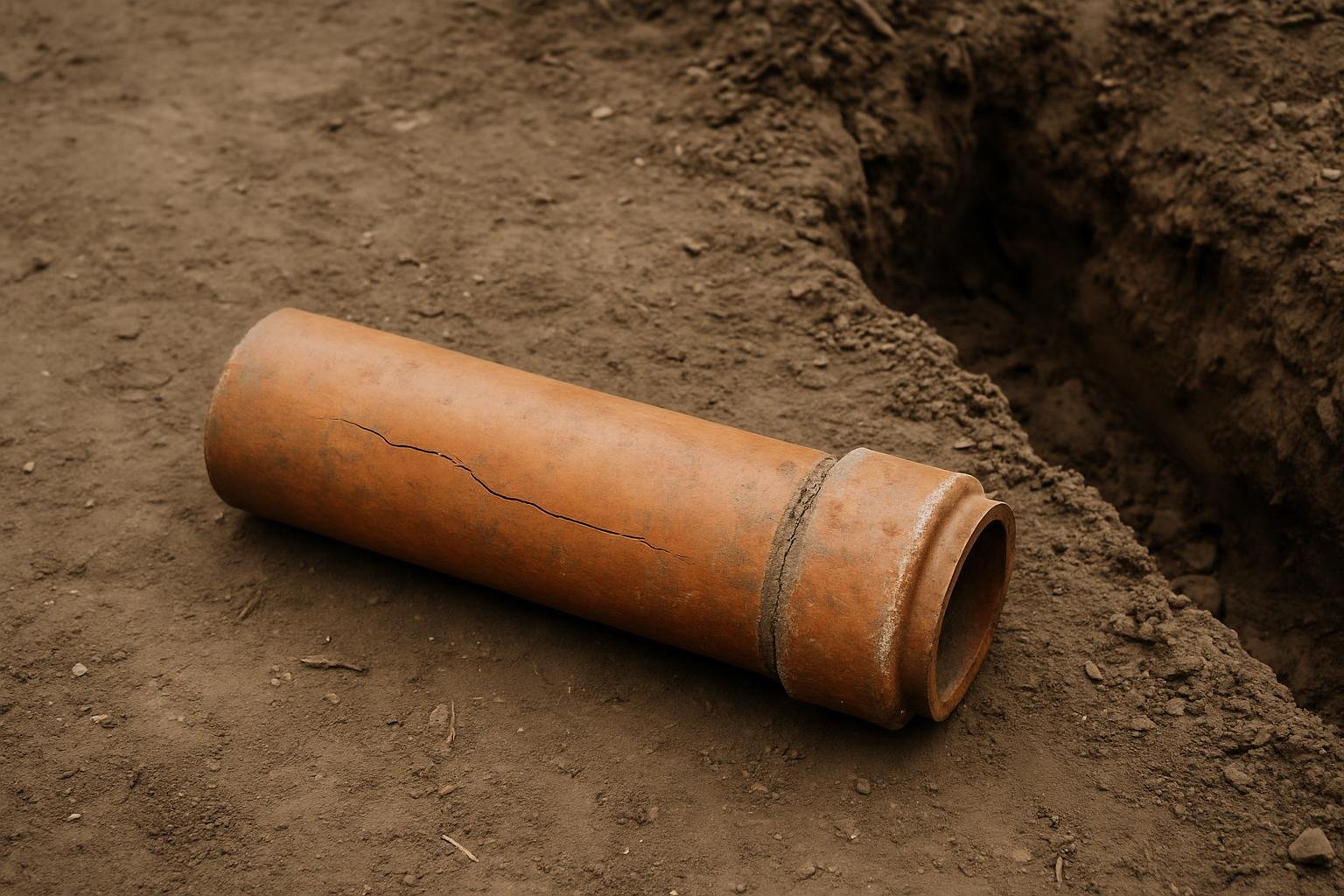
The line that matters is not the front wall of your house and it is not the main under the street. Section 5.3 A.3 of the Onondaga County Examining Board for Plumbers requirements states that all sewer lateral repairs shall be reconstructed to the curb line, and that where a licensed plumbing contractor determines there is an obstruction within the service lateral that cannot be cleared and that obstruction is under the street bed, it is the contractor's responsibility to contact the City sewer department and demonstrate the same. Read that twice, because it does two things at once. It puts the whole run across your yard and out to the curb on you, which is most of the length of the pipe. And it names the single condition under which the problem stops being yours: not that it is near the road, not that it is deep, but an obstruction inside the lateral, under the street bed, that a licensed contractor has established and reported. Nearly everything about the size of this job turns on which side of that description your blockage falls.
The call to make before you pay anybody
Onondaga County Water Environment Protection answers a 24 hour line on 315-435-3157 for properties inside the Consolidated Sanitary District, and its crews will come and inspect the public side of the sewer. The department describes that side as running from the sewer cleanout or vent pipe in your yard, the mushroom cap, out to the road and into the public sewer. There is no direct charge for the visit and you do not have to be at home for it. If the fault turns out not to be in the public sewer, the department refers the property on to a licensed plumber or drain service. That is the cheapest diagnostic step available anywhere in this trade and it is worth taking before you book anything. Be clear about what it settles and what it does not. WEP inspecting a stretch of pipe is a service the department provides; it is not a statement that the department owns that pipe. The curb line rule above is the one that decides who pays for the repair.
Your address decides which number rings
For City of Syracuse properties, WEP says the call goes to the City Department of Public Works on 315-448-CITY, 315-448-2489, and not to the county. Properties outside the Consolidated Sanitary District are told to call their own town or village, usually the municipal Department of Public Works, and properties not connected to a public sewer at all are told to call a licensed plumber. The district itself covers part or all of eighteen municipalities: the City of Syracuse, the towns of Lysander, Camillus, Manlius, Cicero, Onondaga, Clay, Pompey, DeWitt, Salina, Geddes and Van Buren, and the villages of Camillus, East Syracuse, Fayetteville, Liverpool, Manlius and Solvay. The county attaches a warning to that list which is worth repeating, because it catches people out: being inside the district does not by itself mean a given property is or can be served by public sewer. Two houses on one road can sit on different sides of that.
In the city, the DPW flushes your lateral before a plumber may connect to it
Section 5.3 A.2 of the same county requirements states that all sewer laterals in the City of Syracuse must be flushed out by the City of Syracuse Department of Public Works before a plumbing contractor can connect to them, and that WEP Plumbing Control will make no inspection unless the contractor has proof the lateral has been flushed and televised to the main sewer and certifies it to be in good condition. A video recording goes to the City Sewer Department and to Plumbing Control. Section 5.3 A.1 requires approval from the City Engineer or Commissioner of Public Works before WEP will issue a plumbing permit at all. Two things follow. Inside the city a camera survey is not a contractor's extra, it is a filing requirement with a copy held by the City. And the City is a party to work on your side of the curb whether or not it is paying for any of it, which is exactly why its own homeowner guidance reads as though the sewer is entirely a City matter.
Three villages put the cost on the owner, in identical words
Village of Fayetteville Code section 133-10 states that all costs and expense incident to the installation and connection of the building sewer shall be borne by the owner, who shall indemnify the Village against loss. Village of North Syracuse Code section 197-12 and Village of East Syracuse Code section 277-5A carry the identical rule, word for word. That is not three coincidences. It is one model ordinance adopted three times, and it shows how settled the question is in the villages even though no homeowner-facing page says it out loud. If your address is in one of those three, there is no realistic argument that the connection between your building and the public sewer is anybody's expense but yours. What is still very much worth establishing is where along that run the fault sits, because a blockage that gets cleared and a collapsed section that has to be dug out are different pieces of work at wildly different sizes.
East Syracuse is the exception, and it is worth knowing about
Village of East Syracuse Code section 277-5H allows sewer extensions, including individual building sewer laterals to the property line, to be constructed by the Village. That is the one place in this county's codes where a municipality may build the lateral rather than leaving all of it to the owner, and it sits in the same chapter that elsewhere puts installation costs on the owner. Two neighboring clauses matter before you plan anything there. Section 277-5C allows an old building sewer to serve a new building only if the Public Works Superintendent tests it and finds it fully compliant, so reusing what is already in the ground is the Village's decision rather than yours. Section 277-5D requires the building sewer to be brought into the building below the basement floor wherever possible. Ask the Village office which of these applies to your address before anybody quotes you for anything.
Liverpool can require you to connect, at your own expense
Village of Liverpool Code section 295-1 requires the owners of all houses and buildings used for human occupancy in the Village, abutting a street with a public sanitary sewer, at their own expense to install plumbing and connect directly to the public sewer within 180 days of official notice, provided the public sewer is within 100 feet of the property owner's lot line. Two numbers to hold on to: 100 feet, and 180 days. Section 295-5 then describes the system by reference to drawings entitled Village of Liverpool, New York, Sanitary Sewer Details, dated January 1930, which is a fair indication of how long some of this infrastructure has been in the ground and of what a connection is being made to. If a notice like that has arrived, the clock in it is real and the ordinance names the expense as yours.
One building, one lateral, and the exception for a house behind a house
Fayetteville, North Syracuse and East Syracuse all require a separate and independent building sewer for every building. The exception is narrow: where one building stands at the rear of another on an interior lot and no separate route exists, the front building's sewer is extended and the whole run is then treated as one building sewer. Fayetteville adds that a multiple dwelling structure needs at least one separate building sewer for every group of six or fewer family dwelling units, unless the county Division of Drainage and Sanitation agrees otherwise. This is the clause that decides the arguments people actually have: a rear cottage, a converted garage, a two family house on a narrow lot, a shared driveway. If your waste leaves through another building's line, the fault may not be on your land at all, and establishing that before anybody digs is the difference between one repair and one dispute.
Two places that sit outside the county system entirely
The Village of Skaneateles runs its own sewer service and its own wastewater treatment plant on Fennell Street, with its own service line on 315-685-5426, and is not part of the Onondaga County Consolidated Sanitary District at all. It bills sewer monthly, at a base rate for the connection plus a usage charge and a capital project charge. The Town of Marcellus is outside the district too: the capability assessment in its own hazard mitigation annex records that the Town levies no water, sewer, gas or electric user fees while the Village of Marcellus does, and the same annex notes private septic systems on the steep slopes of the northern region of Otisco Lake. If you are on septic, none of the lateral rules above apply to you. That is a different trade with a different regulator, and anybody quoting you sewer work should have asked first.
How to settle it for your own address
Three checks, in order, and none of them needs a contractor. First, look at your Onondaga County real property tax bill. WEP charges a sanitary sewer unit charge to properties in the Consolidated Sanitary District that are connected to public sewer, and a single family home is assessed one unit, so if you are being billed for it you are connected to it. Second, call the number for your municipality above and ask for the public side to be checked. Third, before any work happens, know where the line is drawn on doing it yourself: Onondaga County's local law lets a homeowner take out a permit to alter the plumbing in their own home under narrow conditions, but paragraph 2(b)(4)(e) prohibits any such person from connecting a private sewer to any public sewer in the county. North Syracuse goes further again, requiring the permit application to be made to the county before any sewer construction commences.
What we can do with this, and what we cannot
We are not the plumber. We take what you tell us, match it to licensed, insured contractors who work your municipality, and get out of the way. What we would ask you to do first is the part that costs nothing: work out which side of the curb line your problem is likely to sit on, and make the municipal call for your address. If the public side is at fault you have saved yourself the entire job, and that is a good outcome for you even though it is not one for us. If it is not, you will be talking to a contractor already knowing the one thing that decides how big the work is, which is a very different conversation from the one that starts with somebody guessing in your driveway.
Sources used in this guide
Section 5.3 A.3 of the Onondaga County Examining Board for Plumbers requirements states that all sewer lateral repairs shall be reconstructed to the curb line or edge of pavement, and that if the licensed plumbing contractor determines there is an obstruction within the service lateral that cannot be cleared and the obstruction is under the street bed, it is the plumber's responsibility to contact the City sewer department and demonstrate the same.
Source: Onondaga County Examining Board for Plumbers, Requirements for Implementation of the New York State Fire Prevention and Building Code, accessed 2026-09-08
Onondaga County Water Environment Protection answers a 24 hour line on 315-435-3157 for properties inside the Consolidated Sanitary District, and its crews inspect the public side of the sewer, which it describes as running from the sewer cleanout or vent pipe, the mushroom cap, in your yard out to the road and into the public sewer. If the fault is not in the public sewer the department refers the property to a licensed plumber or drain service. There is no direct charge for the visit and the homeowner does not need to be present.
Source: Onondaga County Department of Water Environment Protection, accessed 2026-09-08
Onondaga County Water Environment Protection states that for City of Syracuse properties the call goes to the City Department of Public Works on 315-448-CITY, 315-448-2489, not to the county. Properties outside the Consolidated Sanitary District are told to call their own town or village, usually the municipal Department of Public Works, and properties not connected to a public sewer at all are told to call a licensed plumber.
Source: Onondaga County Department of Water Environment Protection, accessed 2026-09-08
The Onondaga County Consolidated Sanitary District covers part or all of eighteen municipalities: the City of Syracuse, the towns of Lysander, Camillus, Manlius, Cicero, Onondaga, Clay, Pompey, DeWitt, Salina, Geddes and Van Buren, and the villages of Camillus, East Syracuse, Fayetteville, Liverpool, Manlius and Solvay. The county warns that being inside the district does not by itself mean a given property is or can be served by public sewer.
Source: Onondaga County Department of Water Environment Protection, accessed 2026-09-08
Section 5.3 A.2 of the same requirements states that all sewer laterals in the City of Syracuse must be flushed out by the City of Syracuse Department of Public Works before a plumbing contractor can connect to them, and that no inspection will be made by WEP Plumbing Control unless the contractor has proof the lateral has been flushed and televised to the main sewer and certifies it to be in good condition. A video recording must be given to the City Sewer Department and to Plumbing Control. Section 5.3 A.1 requires approval from the City Engineer or Commissioner of Public Works before WEP will issue a plumbing permit at all.
Source: Onondaga County Examining Board for Plumbers, Requirements for Implementation of the New York State Fire Prevention and Building Code, accessed 2026-09-08
Village of Fayetteville Code section 133-10 states that all costs and expense incident to the installation and connection of the building sewer shall be borne by the owner, who shall indemnify the Village against loss. Village of North Syracuse Code section 197-12 and Village of East Syracuse Code section 277-5A carry the identical rule word for word.
Source: Village of Fayetteville Code Chapter 133; Village of North Syracuse Code Chapter 197; Village of East Syracuse Code Chapter 277, accessed 2026-09-08
Village of East Syracuse Code section 277-5H allows sewer extensions, including individual building sewer laterals to the property line, to be constructed by the Village. Section 277-5C allows old building sewers to be used with new buildings only if the Public Works Superintendent tests them and finds they fully comply. Section 277-5D requires the building sewer to be brought to the building below the basement floor wherever possible, and section 277-5E prohibits any source of surface runoff or groundwater from being connected to a building sewer.
Source: Village of East Syracuse Code Chapter 277, Sewers, accessed 2026-09-08
Village of Liverpool Code section 295-1 requires the owners of all houses and buildings used for human occupancy in the Village, abutting a street with a public sanitary sewer, at their own expense to install plumbing and connect directly to the public sewer within 180 days of official notice, provided the public sewer is within 100 feet of the property owner's lot line. Section 295-5 describes the system by reference to drawings entitled Village of Liverpool, New York, Sanitary Sewer Details, dated January 1930.
Source: Village of Liverpool Code Chapter 295, Sewers, accessed 2026-09-08
Fayetteville, North Syracuse and East Syracuse all require a separate and independent building sewer for every building, with a narrow exception where one building stands at the rear of another on an interior lot and no separate route exists, in which case the front building's sewer is extended and the whole run is treated as one building sewer. Fayetteville adds that a multiple-dwelling structure needs at least one separate building sewer for every group of six or fewer family dwelling units unless the county Division of Drainage and Sanitation agrees otherwise.
Source: Village of Fayetteville Code section 133-11; Village of North Syracuse Code section 197-13; Village of East Syracuse Code section 277-5B, accessed 2026-09-08
The Village of Skaneateles runs its own sewer service and wastewater treatment plant at 3831 Fennell Street, with its own service line on 315-685-5426, and bills sewer monthly at a $22.00 base rate for the connection plus $0.12208 per cubic foot of usage and a $0.043 per cubic foot capital project charge, effective June 2026. The Village is not part of the Onondaga County Consolidated Sanitary District.
Source: Village of Skaneateles, New York, accessed 2026-09-08
The capability assessment in the Town of Marcellus annex to the 2025 county hazard mitigation plan records that the Town does not levy user fees for water, sewer, gas or electric service, while the equivalent table in the Village of Marcellus annex records that the Village does. The Town of Marcellus is not a member of the Onondaga County Consolidated Sanitary District, and the only utility facilities the Town annex names are the Otisco Lake Dam and an Onondaga County Water Authority water pump station. The same annex notes private septic systems on the steep slopes of the northern region of Otisco Lake.
Source: Onondaga County 2025 Multi-Jurisdictional Hazard Mitigation Plan, accessed 2026-09-08
WEP charges a sanitary sewer unit charge on the Onondaga County real property tax bill to properties in the Consolidated Sanitary District that are connected to public sewer. One sewer unit equals 85,000 gallons of water for the 2026 tax year, reduced from 100,000 gallons in 2025. A single-family home is assessed one unit. Properties on private septic are not billed, and WEP states that if a septic system fails and sewer service is available, hookup becomes mandatory under public health codes.
Source: Onondaga County Department of Water Environment Protection, accessed 2026-09-08
The same local law lets a homeowner take out a permit to alter the plumbing in their own home, but only where the title is in that person's name or jointly with a spouse, the home is no larger than one family size, a letter of intent has been submitted to Plumbing Control, and the work is inspected by a county plumbing inspector. Paragraph 2(b)(4)(e) then states that it shall be prohibited for any such person to connect a private sewer to any public sewer within the County of Onondaga.
Source: Onondaga County Local Law No. 9 of 1988, as amended by Local Law No. 6 of 2004, Section 2(b)(4), accessed 2026-09-08
Village of North Syracuse Code section 197-7 forbids anyone to uncover, connect to, open into, use, alter or disturb any public sewer without a permit, and section 197-8 requires that the application for that permit be made to the county before any sewer construction commences. Section 197-15 refers the size, slope, alignment, materials, excavation, jointing, testing and backfilling to the New York State Uniform Code and the Onondaga County Sanitary Code, and section 197-19 requires that the connection be made under the supervision of the Superintendent.
Source: Village of North Syracuse Code Chapter 197, Article III, accessed 2026-09-08
Services this guide relates to
Need someone to look at it?
Send the details and we will come back to you.