
Sewer Line Cleaning on North Syracuse Post-War Laterals
On a village house of the right age the camera earns its place before the cable does, because the wrong tool in a fiber pipe turns a cleaning into a replacement.
Sewer Line Cleaning quote in North Syracuse
Share a few details so we can confirm coverage and arrange the right next step.
Would you rather talk it through? Call (315) 640-3590, answered 24/7.
$100 off your first job
Credited by us on your first booked job.
- One credit per customer per property, on your first booked job.
- Valid through December 31, 2026.
Mention this offer when you book. Full terms.
55.3 percent of North Syracuse sits in the fiber pipe window
Share of housing built between 1940 and 1969, the years bituminized fiber sewer pipe was in production under federal Commercial Standard CS116, in the places of Onondaga County: Fairmount 72.3 percent, Seneca Knolls 71.8, Westvale 71.2, Galeville 70.6, Mattydale 65.4, Nedrow 59.1, Lyncourt 56.1, North Syracuse village 55.3, DeWitt hamlet 51.9, Fayetteville village 45.4, Manlius village 44.3, Lakeland 40.7, Solvay village 39.9, Camillus village 38.1, Marcellus village 35.3, Syracuse city 33.4, East Syracuse village 33.1, Minoa village 29.5, Liverpool village 29.3, Baldwinsville village 22.2 and Skaneateles village 20.8.
Source: US Census Bureau, American Community Survey 2020-2024 5-year, table B25034, accessed 2026-09-08
The City of Ann Arbor's building department describes Orangeburg as the brand name of a bituminous fiber pipe made from plant-based fibers and asbestos soaked in a tar-like substance, manufactured to ASTM D-1861 for homogeneous pipe and ASTM D-1862 for the laminated wall version, and states that bituminous fiber piping systems have experienced numerous failures over the years with many needing complete replacement. It puts the usage window at roughly the early 1950s to the early 1970s, with reports of it in homes as early as 1949, and notes that no municipal record identifies which houses have it. It lists a video scan of the line as a way to identify it and warns that inserting a rooter, snake or mechanical cutter may yield clues but may also further damage the pipe.
Source: City of Ann Arbor, Building, Rental and Inspection Services, accessed 2026-09-08
The Oak Orchard Wastewater Treatment Plant at 4300 Oak Orchard Road in Clay, operating since spring 1981, serves a large section of the Town of Clay as well as portions of the Town of Cicero and the Village of North Syracuse through a network of gravity sewers and pumping stations. It replaced the Davis Road Treatment Plant, which had discharged low-quality water and become a public hazard and is now a pump station.
Source: Onondaga County Department of Water Environment Protection, accessed 2026-09-08
Why a cutting head is the wrong first move on a 1950s village line
There is one thing worth checking before a machine goes into a North Syracuse lateral, and it is the year the house went up. 55.3 percent of village housing was built between 1940 and 1969, the production window for bituminized fiber sewer pipe, and the building department that has published most on that material warns plainly that inserting a rooter, snake or mechanical cutter may yield clues but may also further damage the pipe. It also notes that no municipal record says which houses have it, so a video scan is how anyone finds out. On a village address of that vintage, a camera first is not caution for its own sake, it is the cheaper order of work.
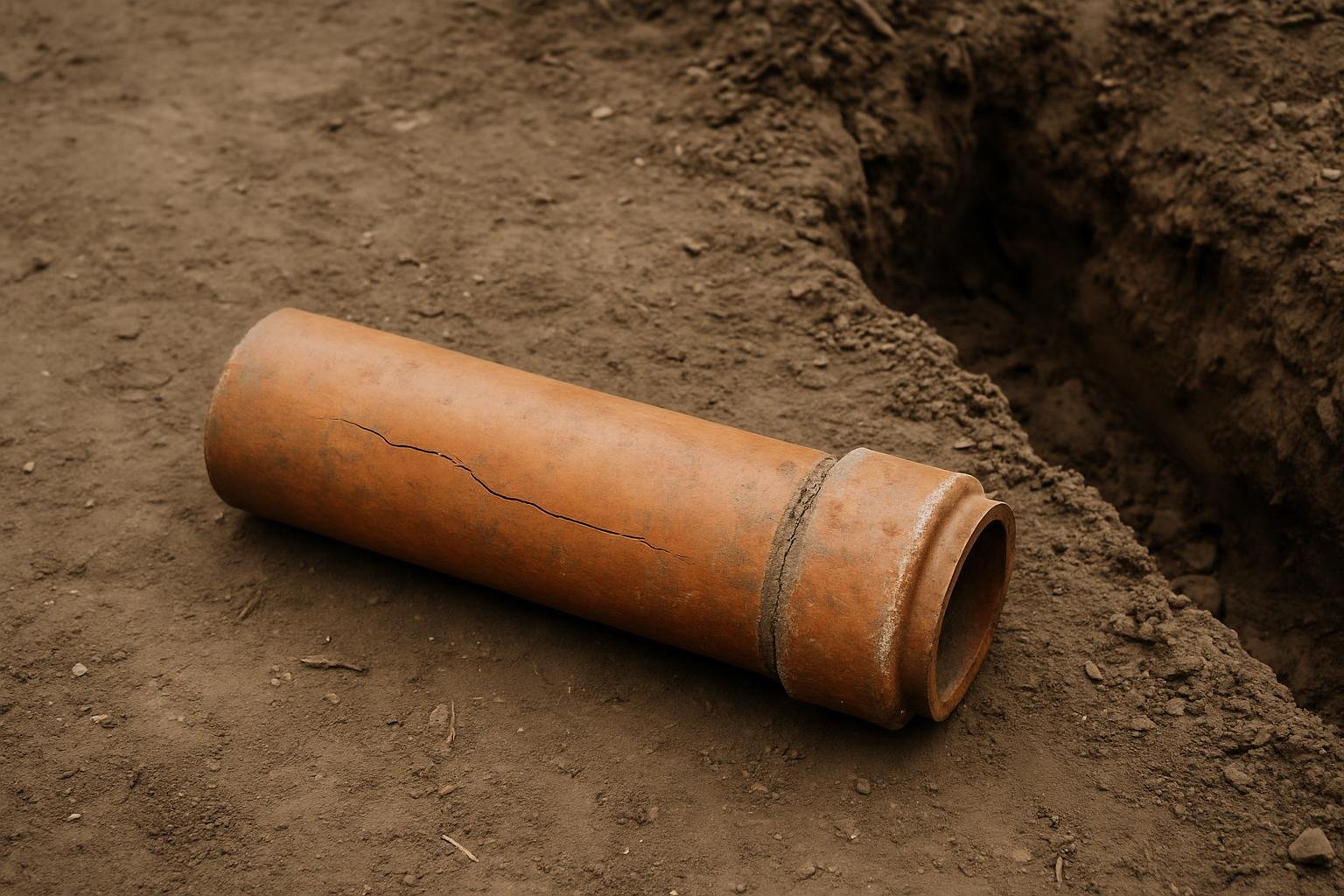
Camera first or cable first on a North Syracuse lateral
Weigh the failure pattern, not just the symptom. A line that blocks, clears and behaves for a year or two is usually carrying a deposit, and a jetter or a cutting head sized to the bore is the right answer. A line that has collapsed before, that goes oval on camera, or that fails again within weeks is telling you the pipe has lost its shape, and cabling that is spending money to make it worse. The village also drains north through gravity sewers and pumping stations to the Oak Orchard plant in Clay rather than south to Metro, so when a whole street stops moving at once the question sits with a county pump station before it sits with your lateral.
Date the house before you choose the tool
More than half of North Syracuse went up inside the fiber pipe window. That single fact changes whether a mechanical cutter is a repair or a risk.
Repeat failure is a shape problem
Blocking once a decade is deposit. Blocking every few months, or collapsing, is a pipe that no longer holds its own diameter, and no amount of cleaning restores that.
A whole street at once is not your pipe
The village runs north to Oak Orchard through pumping stations. If nearby houses slow on the same morning, that is a county question and worth raising before you pay for private work.
Has this line failed before?
Tell us how many times and how far apart, and we will say whether a survey has to come ahead of a cleaning.
Other work we arrange on North Syracuse laterals
What village owners ask before a machine enters the line
How do I find out if my North Syracuse line is bituminized fiber?
You look at it. No municipal record identifies which houses have it, and the material was in ordinary use through the years most of this village was built, so a video scan of the line is the identification method. That is also why a survey is worth doing before a cutting head rather than after.
Is jetting safer than cabling on an older village lateral?
It depends what the camera shows first. Jetting scours a grease coated wall rather than boring a channel through the deposit, which is the right approach on a sound pipe carrying build-up. On a pipe that has already deformed, neither tool is a fix, and the honest answer is that the money belongs in a repair instead.
Tell us what the North Syracuse line keeps doing
Send your ZIP code and the age of the house. There is no obligation, and we will say which order the work should run in.